10 signatures reached
To: Logan County Board of Commissioners, Logan County, Nebraska
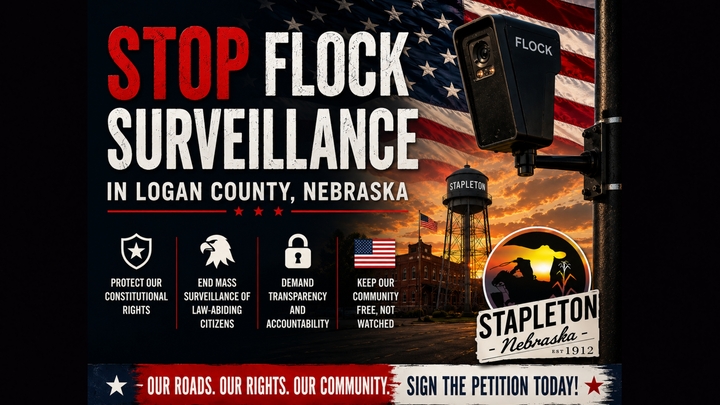
Stop Flock Surveillance Cameras in Logan County, Nebraska

We, the residents and concerned citizens of Logan County, Nebraska, call on the Logan County Board of Commissioners to discontinue the use of Flock Safety automated license plate reader (ALPR) cameras in our community.
"Recently my colleagues at the ACLU of Massachusetts carried out a broad statewide open-records project, and among their findings is that Flock’s default agreement with police departments gives the company the right to share data with federal and local agencies for “investigative purposes” even if a local department chooses to restrict data to its own officers."
~ Jay Stanley, a Senior Policy Analyst with the ACLU’s Speech, Privacy, and Technology Project.
• It comes from his ACLU article “Flock Can Share Driver-Surveillance Data Even When Police Departments Opt Out, And Other Flock Developments,” published October 24, 2025
These cameras do more than simply photograph vehicles involved in crimes. They collect and store information about vehicles traveling through our community, creating records that can be searched and potentially accessed through law-enforcement data-sharing networks.
Public safety is important, but so are privacy, transparency, accountability, and the constitutional rights of law-abiding citizens. Residents should not have their movements routinely recorded simply because they drive on public roads.
Before taxpayer money is used to maintain or expand this surveillance system, Logan County residents deserve clear answers about how the technology is being used, how often it has actually assisted local criminal investigations, what information is retained, who can access that information, and which outside agencies have access to Logan County's Flock network.
We therefore ask the Logan County Board of Commissioners to terminate the county's use of Flock Safety cameras and refrain from renewing or expanding the program.
At minimum, we ask that the program be suspended until its costs, effectiveness, privacy implications, data-sharing practices, and actual local law-enforcement use can be fully disclosed and reviewed in a public meeting.
Public safety should not require giving up public accountability or the privacy of an entire community.
"Recently my colleagues at the ACLU of Massachusetts carried out a broad statewide open-records project, and among their findings is that Flock’s default agreement with police departments gives the company the right to share data with federal and local agencies for “investigative purposes” even if a local department chooses to restrict data to its own officers."
~ Jay Stanley, a Senior Policy Analyst with the ACLU’s Speech, Privacy, and Technology Project.
• It comes from his ACLU article “Flock Can Share Driver-Surveillance Data Even When Police Departments Opt Out, And Other Flock Developments,” published October 24, 2025
These cameras do more than simply photograph vehicles involved in crimes. They collect and store information about vehicles traveling through our community, creating records that can be searched and potentially accessed through law-enforcement data-sharing networks.
Public safety is important, but so are privacy, transparency, accountability, and the constitutional rights of law-abiding citizens. Residents should not have their movements routinely recorded simply because they drive on public roads.
Before taxpayer money is used to maintain or expand this surveillance system, Logan County residents deserve clear answers about how the technology is being used, how often it has actually assisted local criminal investigations, what information is retained, who can access that information, and which outside agencies have access to Logan County's Flock network.
We therefore ask the Logan County Board of Commissioners to terminate the county's use of Flock Safety cameras and refrain from renewing or expanding the program.
At minimum, we ask that the program be suspended until its costs, effectiveness, privacy implications, data-sharing practices, and actual local law-enforcement use can be fully disclosed and reviewed in a public meeting.
Public safety should not require giving up public accountability or the privacy of an entire community.
Why is this important?
This issue is not about being against law enforcement or being against public safety. It is about deciding how much surveillance we are willing to accept in our community and ensuring that powerful technology is subject to transparency and public oversight.
Flock Safety cameras are automated license plate readers. They photograph passing vehicles and record information associated with those vehicle sightings. That means the system doesn't only collect information about suspected criminals—it collects information about ordinary people going to work, taking their children to school, visiting friends, attending church, going to the doctor, or simply driving through town.
That information can become searchable by law enforcement, and Flock operates a large network through which agencies can share access to vehicle data. Logan County residents deserve to know exactly who can access information collected here and what safeguards prevent that information from being misused.
~•~•~•~•~•~•~•~•~•~•~•~•~•~•~•~•~•~•~
August 12, 2026
The IJ Database of ALPR Abuse
The Institute for Justice has cataloged more than 100 incidents of ALPR abuse, including romantic stalking, wrongful stops and detentions, non-law enforcement use, and other types of misconduct.
Automated license plate readers (ALPRs) were sold to American communities as a targeted tool for catching car thieves and finding missing people. What they actually purchased has grown into something far broader and more frightening: an AI-powered network of cameras that photograph and log the movement of every driver who passes, whether or not they are suspected of any crime.
Companies like Flock Safety have now blanketed thousands of communities with ALPRs, quietly assembling powerful mass surveillance systems that can reconstruct where people have been, when, and how often, all without a warrant.
This dragnet surveillance threatens the freedoms the Fourth Amendment was adopted to protect. These concerns aren’t just abstractions: every day, innocent people are harmed by officials’ abuse and misuse of these ALPRs. Here are just a few examples:
• In Florida, a woman was stalked and pulled over by a sheriff’s deputy who saw her at a TV shoot.
• In Texas, a sheriff’s deputy used 83,000 Flock ALPRs to find a woman who had allegedly had a medication abortion, at the behest of her abusive partner.
• In Georgia, a police chief tracked his ex-girlfriend and her teenage daughter roughly 600 times.
All told, the Institute for Justice (IJ) has identified well over 100 incidents of ALPR abuse, including romantic stalking, wrongful stops and detentions, non-law enforcement use, and other types of misconduct.
Although this is the most comprehensive list publicly available, it may be just the tip of the iceberg. Officers rarely enter specific reasons when they search ALPR databases, and the volume of searches is so large that it would be impossible to figure out whether officers’ vague justifications are actually true.
For instance, in litigation against Norfolk, Virginia, IJ discovered that the top three search reasons (“cj,” “stolen,” and “inv”) accounted for nearly one third of 230,000 searches over two years. One officer repeatedly wrote “la la la la,” and nobody noticed.
When the government can track the everyday movements of ordinary people—to their jobs, their churches, their doctors, their protests—it holds a kind of power over private life that the Constitution does not allow.
~•~•~•~•~•~•~•~•~•~•~•~•~•~•~•~•~•~•~
There is also a basic question of effectiveness. If taxpayers are paying for a surveillance system that records thousands of innocent motorists, the public deserves evidence showing what benefit Logan County is actually receiving. How many crimes has it helped solve here? How many arrests or stolen-vehicle recoveries has it produced? How frequently is the system searched? Who has access?
These are reasonable questions, and citizens should be able to ask them without being dismissed or treated with hostility.
Technology that gives the government greater ability to monitor people's movements deserves greater oversight—not less.
We can support law enforcement while also demanding privacy, accountability and transparency from our government. Those principles are not mutually exclusive.
Please sign this petition if you believe Logan County residents deserve a meaningful voice in whether this type of surveillance continues in our community.
Flock Safety cameras are automated license plate readers. They photograph passing vehicles and record information associated with those vehicle sightings. That means the system doesn't only collect information about suspected criminals—it collects information about ordinary people going to work, taking their children to school, visiting friends, attending church, going to the doctor, or simply driving through town.
That information can become searchable by law enforcement, and Flock operates a large network through which agencies can share access to vehicle data. Logan County residents deserve to know exactly who can access information collected here and what safeguards prevent that information from being misused.
~•~•~•~•~•~•~•~•~•~•~•~•~•~•~•~•~•~•~
August 12, 2026
The IJ Database of ALPR Abuse
The Institute for Justice has cataloged more than 100 incidents of ALPR abuse, including romantic stalking, wrongful stops and detentions, non-law enforcement use, and other types of misconduct.
Automated license plate readers (ALPRs) were sold to American communities as a targeted tool for catching car thieves and finding missing people. What they actually purchased has grown into something far broader and more frightening: an AI-powered network of cameras that photograph and log the movement of every driver who passes, whether or not they are suspected of any crime.
Companies like Flock Safety have now blanketed thousands of communities with ALPRs, quietly assembling powerful mass surveillance systems that can reconstruct where people have been, when, and how often, all without a warrant.
This dragnet surveillance threatens the freedoms the Fourth Amendment was adopted to protect. These concerns aren’t just abstractions: every day, innocent people are harmed by officials’ abuse and misuse of these ALPRs. Here are just a few examples:
• In Florida, a woman was stalked and pulled over by a sheriff’s deputy who saw her at a TV shoot.
• In Texas, a sheriff’s deputy used 83,000 Flock ALPRs to find a woman who had allegedly had a medication abortion, at the behest of her abusive partner.
• In Georgia, a police chief tracked his ex-girlfriend and her teenage daughter roughly 600 times.
All told, the Institute for Justice (IJ) has identified well over 100 incidents of ALPR abuse, including romantic stalking, wrongful stops and detentions, non-law enforcement use, and other types of misconduct.
Although this is the most comprehensive list publicly available, it may be just the tip of the iceberg. Officers rarely enter specific reasons when they search ALPR databases, and the volume of searches is so large that it would be impossible to figure out whether officers’ vague justifications are actually true.
For instance, in litigation against Norfolk, Virginia, IJ discovered that the top three search reasons (“cj,” “stolen,” and “inv”) accounted for nearly one third of 230,000 searches over two years. One officer repeatedly wrote “la la la la,” and nobody noticed.
When the government can track the everyday movements of ordinary people—to their jobs, their churches, their doctors, their protests—it holds a kind of power over private life that the Constitution does not allow.
~•~•~•~•~•~•~•~•~•~•~•~•~•~•~•~•~•~•~
There is also a basic question of effectiveness. If taxpayers are paying for a surveillance system that records thousands of innocent motorists, the public deserves evidence showing what benefit Logan County is actually receiving. How many crimes has it helped solve here? How many arrests or stolen-vehicle recoveries has it produced? How frequently is the system searched? Who has access?
These are reasonable questions, and citizens should be able to ask them without being dismissed or treated with hostility.
Technology that gives the government greater ability to monitor people's movements deserves greater oversight—not less.
We can support law enforcement while also demanding privacy, accountability and transparency from our government. Those principles are not mutually exclusive.
Please sign this petition if you believe Logan County residents deserve a meaningful voice in whether this type of surveillance continues in our community.